
Understanding before deciding what matters
Most significant projects don't fail because people don't work hard. More often, they struggle because teams move too quickly from recognising a problem to implementing a solution.
Whether we're developing a strategy, redesigning a service or investing in new technology, the quality of the solution depends on how well we understand the problem.
That's where discovery comes in.
Discovery isn't about collecting as much information as possible. It's about building enough understanding to be confident we're solving the right problem.

Discovery helps uncover new perspectives. Photo: Chris Garant, Unsplash
Discovery is about seeing through multiple lenses
I've been project planning for a discovery process. That, combined with an MIT Sloan article on empathy, got me thinking about how we build understanding.
The MIT Sloan research says empathy is one of the key human skills in an AI world.
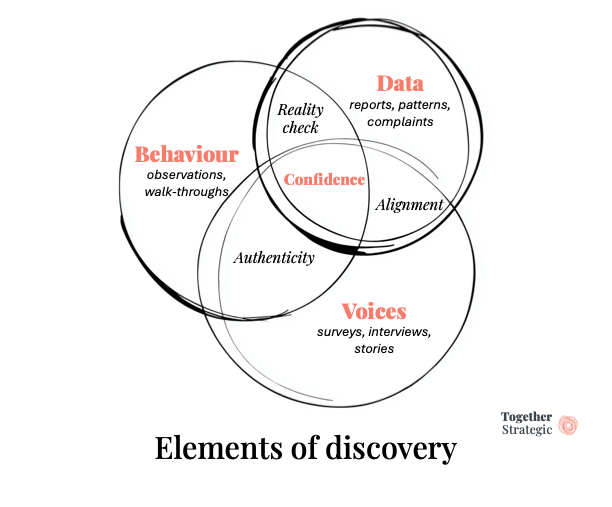
As I was working I sketched out a recipe for building empathy into project design, and for testing what goes into an empathy map. Three ingredients kept appearing.
Data – reports, patterns, usage, complaints.
Voices – what people tell us through surveys, stories and interviews.
Behaviours – what people actually do through observations, walk-throughs and talk-alouds.
Projects don't need to overcook it. I've found just a pinch of all three and you'll have more confidence in what's going on.
When data lines up with people's stories, you've got alignment. When people's stories match their actions, you've got authenticity. And when the numbers reflect what you actually see happening, you've got a reality check.
Data, voices and behaviours are simply different lenses that help us build a clearer picture of people's experience.
What discovery looks like at scale
The same thinking applies whether you're talking to five people or five hundred.
The challenge changes, though. Discovery is powerful, but it can also overwhelm. When you're faced with a mountain of information, the challenge eventually shifts from collecting more data to knowing what matters.
One project brought this into focus.
Ahead of developing a new local government IT Strategy and Core Systems Renewal Program, we set out to understand where the real pain points were for staff, and pulled together a co-design team comprising staff from across the organisation.
IT projects are often viewed through a purely technical lens, and they're a significant investment. We wanted to take a different tack: a human-centred discovery process at scale, broadly framed around business capability.
We engaged directly with staff through surveys and workshops, asking what mattered and where systems, tools and processes weren't supporting them.
Over the course of the project we brought together more than 900 verbatim comments from a staff survey and 19 team workshops. We looked at system data through reports including CRM information and service desk requests. And we mapped what each team relied on to do their work.
At some point, collecting information stopped being the challenge - it became making sense of it.
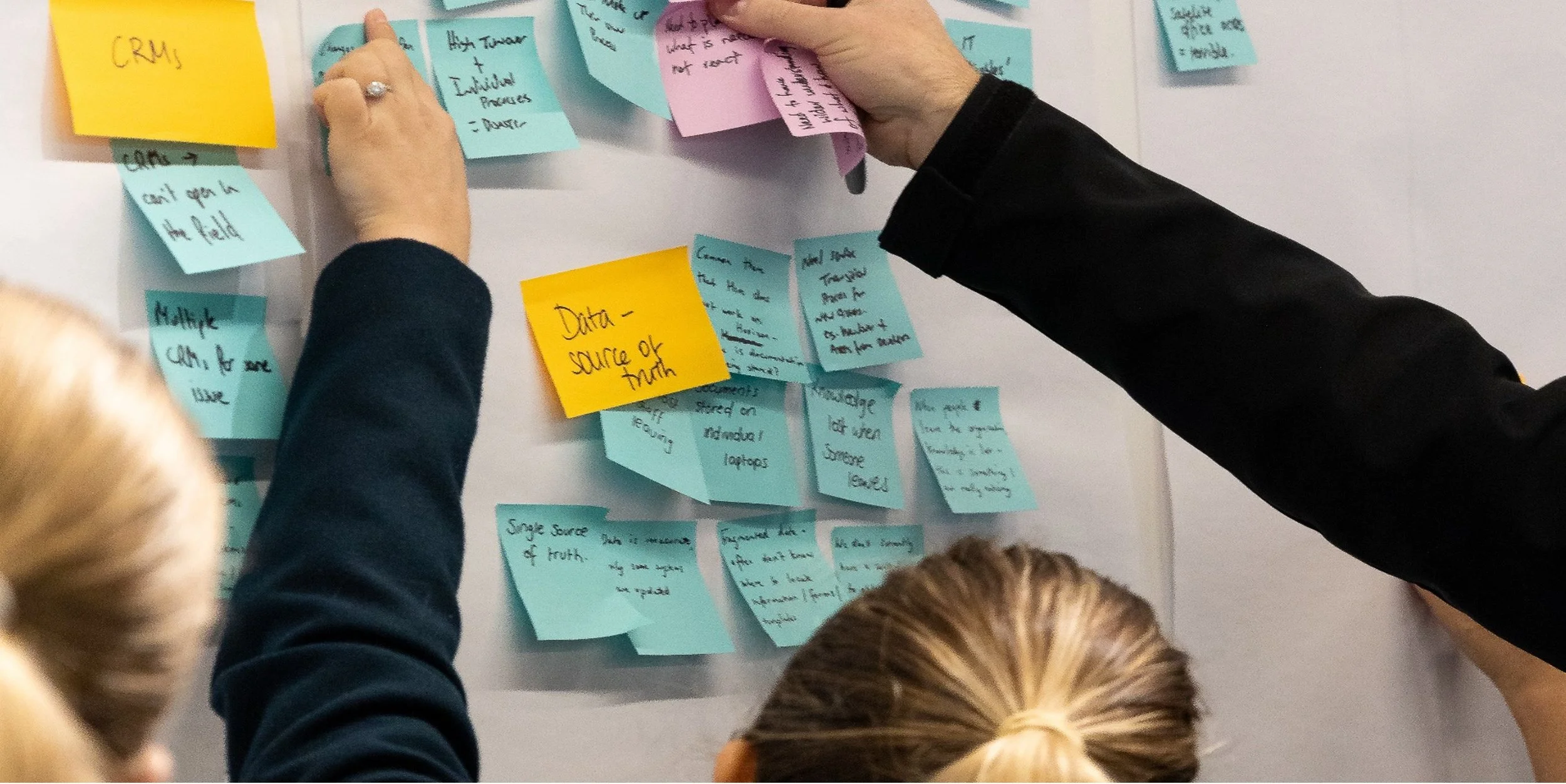
Theming the challenges by the co-design staff team
Four questions that helped us make sense of complexity
Four questions helped us move from collecting information to understanding what really mattered.
Do we have multiple perspectives and ways of looking at the challenge?
What patterns are emerging in what we're hearing?
Do we have a full enough picture to be confident?
Which issues are simply interesting, and which fundamentally change the organisation's ability to deliver?
These questions helped us synthesise hundreds of data points, stories and quotes into a handful of key insights, and frame the key problems to solve. From there, the next step was getting to work on how we might do that.
Discovery isn't about delaying decisions. It's about making better ones. The time invested upfront often pays for itself by giving leaders greater confidence they're solving the right problem, rather than simply the most obvious one.
Whether you're planning a new strategy, redesigning a service or investing in technology, discovery helps teams move beyond assumptions towards shared understanding. Because when we understand the problem more clearly, we're much more likely to find the right solution.